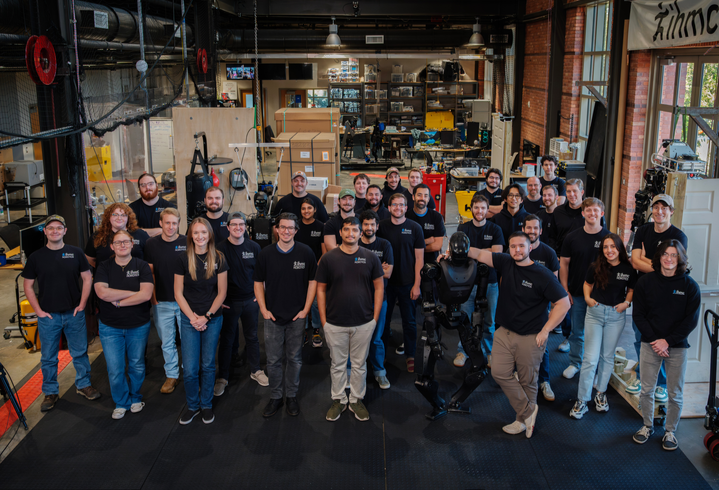
IHMC Robotics enhances the human condition through innovations in
robotics, wearables, and human-machine teaming.
IHMC researchers are pushing the envelope of what is possible in the domain of robotics. We have an interdisciplinary group composed of expertise in mechanical engineering, electrical engineering, computer science, mathematics, physics, human factors, and interface design. Our group has several different areas we are focusing on:
Legged Robotics
With over 20 years in humanoids research, IHMC has developed a number of robots like M2V2, Nadia, and most recently, Alex, innovating on design approaches, tools, and analysis techniques. While hydraulics offer extreme power density and versatility, electric actuation offers improved performance, ease of maintenance, and scalability, making it a more practical solution in the current landscape. Beyond platform design, we focus is on developing control algorithms for humanoid robots, including Alex robot, NASA Johnson Space Center's Valkyrie humanoid robot, and other off-the-shelf humanoid platforms. Additionally, we work on autonomous robot behaviors tailored for urban exploration, breaching operations, and remote work in space applications.
We are committed to develop systems that can also function as human avatars and teammates in dynamic, unstructured environments—places where pre-learned autonomy alone would not suffice. These environments demand real-time adaptation, requiring advanced human cognition and the development of adaptive techniques. To effectively direct robot autonomy or develop humanoids as avatars, it is essential to create systems that seamlessly integrate with human operators. For this reason, we focus on the design and development of efficient operator interfaces and intuitive human-machine interfaces, enabling real-time collaboration between humans and robots.
Exoskeletons
Our research in wearable robotics has developed several variations of lower body exoskeleton devices. These devices encompass a vast array of applications including mobility assistance for spinal paraplegic injuries, strength amplification for able-bodied users, and compact resistance exercise for astronauts in space. By collaborating with other leaders in the field such as NASA Johnson Space Center, we hope to advance the state of the art in wearable robotics to be compact, light-weight, safe, and an avenue for increasing the quality of life and performance across a wide variety of challenging and critical situations. We're also working with the Department of Energy and Sandia National Labs to develop augmentative exoskeletons that offload the weight of heavy PPE to prevent long-term biomechanical injury.
Human-Machine Teaming
IHMC is at the forefront of advancing human-machine teamwork, focusing on developing robots that can collaborate effectively with humans in dynamic environments. Our research centers around the concept of Coactive Design, which emphasizes interdependence between team members—both humans and robots. Incorporating these insights, Joint Activity Graphs (JAGs) provide a foundation for modeling and implementing joint activities in teams. Our research has been applied in various domains, including autonomous vehicle systems, military applications, and disaster response.
Building on our focus on human-machine teaming, one of our key projects, the VR Workbench Project, aims to develop an advanced VR system for military training. This system enhances the speed and efficiency of strategy evaluation and the adoption of new technologies. By leveraging simulation, the VR Workbench enables rapid testing and adaptation of strategies, directly supporting decision-making in complex and high-stakes environments.
Public Outreach
Additionally, we are interested in community outreach and helping the public better understand the abilities and limitations of robotics. One of the goals at IHMC is to engage in public outreach through Science Saturdays, Robotics Camps, and open house events to instill this understanding and an interest in the work that we do. We attempt to do this by introducing robots to people’s lives and inspiring the children that will become future roboticists to pursue paths that will help make sure that there is no shortage of talented scientists, researchers, and engineers ready to help develop the next great robot.